Saturday, April 27, 2019

Rubik's Cube

Hey everyone! For my last blog post I wanted to do something creative and reflective that was also unique and meaningful specifically for myself. It took me forever to come up with this idea so I hope that you enjoy!

As many of you all probably know by now, I really like solving all different kinds of Rubik's cubes. I have the normal one of course but I also have a crazy number of variation cubes that are each different like the 4x4 up to the 7x7, dodecahedron, mirror cube, ghost cube (the BEST!), etc. (if you know what all of these are I am so proud :)) But anyways, when I was thinking about what I wanted to do for this blog post, I wanted it to have personal meaning so I decided to summarize my years in high school (and one special middle school moment oh no) in a Rubik's cube.

Each of the sides of the cube is organized by a different year of high school or a really meaningful part of my life during the past four years. I replaced each of the blocks on the cube with a different picture. I pasted each side below with a short explanation but keep scrolling to see pictures of the actual cube that I made!

Side One: Senior Year


This senior year has been amazing. I truly can't believe that it is almost over! It has definitely been the most academically challenging for me because I decided to take all IB/AP classes while also applying to college. It has also been insanely busy because I took leadership positions in three different clubs while also playing club soccer and participating in WAY too many clubs for my own good. But it was honestly so worth it because I got to meet so many different people that I never would have met otherwise. I have become friends with so many great people this year that I know will do great things in their futures.

Side Two: Junior Year


Junior year was great because I hadn't really felt challenged academically at all sophomore year. Joining IB was a great decision for me because I felt like I was able to grow as a student and a learner. It was also a really exciting year because I turned 16 and got to get my license, joined MEB for my first year, became a junior marshal, got inducted into NHS, and went to prom for the first time. I was nervous about committing to so many different things at the beginning of the year but they were all things that I really enjoyed being a part of. It was overall a really fun year where I felt like I made many great friendships.

Side Three: Sophomore Year


This year was definitely a transition year and so it was naturally more difficult than junior or senior year.  It was my first year at Millbrook and there were so many more people in my grade than I had ever been used to. I was really lucky that I had a twin going through the exact same thing and that I happened to have both lunches with the one other person I knew at Millbrook (shoutout to Waverly!). That made it so much easier because I never had to sit alone and I got to meet so many great people in my classes and at lunch because everyone sat in the cafeteria. I remember my first day at lunch at Millbrook I met Graycen and then the second day I met Michael, Cole, and Joslin. I was quite shy so reaching out to new people was really difficult for me. But the year got progressively easier as I joined different clubs, like sophomore class council, and started talking to more people in each of my classes. The year was not all too challenging academically, compared to my freshman year at least, so it made the transition much easier.

Side Four: Freshman Year


It is funny to notice how the camera quality gets progressively worse the farther the pictures go back :). Also, look at the top left picture to see one of the hundreds of selfies that Josh took on my phone (big mistake). But anyways, this year was the most difficult for me out of all of my years in high school. I was at a school with eight people in my grade including myself, and also Nicole (yep, we made up 25% of the class). Things were really difficult for me because the academic workload was insanely challenging for freshman year (about as much as junior year in IB) and I didn't feel like I had any friends to rely on or talk to. I think the most important thing for me that year to get me through was soccer. It was a great year for soccer because I had an amazing and kind team that even won state cup and went to regionals. I became a lot closer with my teammates and dedicated a lot of time to getting better at the game. The bottom right picture is the one special middle school moment and you can see me, Josh, and Nicole at our middle school dance!

Side Five: Soccer


Soccer has been such an important part of my life throughout all of high school. I have played both club and school soccer and never stopped loving the game. It has given me some amazing memories like going to regionals twice with my teammates, being the top scorer on JV, playing obnoxiously loud games in the hotels at tournaments, and scoring a game winning goal (center) against Leesville and then a game tying header again against Leesville in the last minute of the game (bottom left corner, I almost got tackled by the 100 people trying to give me a hug). My teammates have always been a support system for me and the game has given me a space where I don't have to think about anything else, I can just play.

Side Six: Traveling


Last, but not least, I wanted to reflect on all of the trips that I have gone on throughout high school because I am so grateful for all of the experiences and time spent with family I have gotten as a result. My family lives all over the world so I don't see them very often but these trips give us the time and memories that we have together. Spending time with my cousins that live in Belgium is no small thing and these trips have given me that opportunity. My uncle in Belgium even let me shadow him in the hospital that he works at which was an incredible experience. I have been so fortunate to be able to visit my family that lives in so many different places while also being able to experience other cultures and parts of the world.

So I actually printed these six sides to the cube and constructed it so that I could actually have a keepsake from all throughout high school. Here are a few pictures of the real thing (it looks a lot better in person, the pictures also turned out a little blurry).


Thank you to everyone for making this such a great year and high school experience!


Sunday, April 7, 2019

Saturday, March 23, 2019

The American Dream

To me, the "American Dream" is this idea of hope that allows people to rise from poverty in a land of opportunity. It is the idea of a country that gives people freedom and does not confine people to famine and desolation. To me, is represents a chance for anyone to attain prosperity. When I think of the American Dream, I often think about how it is represented through Ellis Island and the Statue of Liberty.

Ellis Island, located in the New York Harbor, was the United States' largest immigration center from 1892 to 1924 ("History & Culture"). Over 12 million immigrants passed through rigorous physical and mental examinations to determine whether they should be let into the country or not. It is often described as an "Island of Hope", or for those denied entry, an "Island of Tears" ("History & Culture"). It symbolized a gateway to opportunity, and with the Statue of Liberty in the sight line, an entrance to a land of freedom. Immigrants spent their lives' earnings to buy a boat ticket to America because of this idea of the American Dream, this great symbol of hope and escape from the economic hardships of the rest of the world. Immigrants would endure terrible living conditions on cramped steam ships, with rampant diseases, for the idea of the American Dream and a better life. To me this shows the influence of the ideology and its core foundation in the idea of hope and the fundamental human right of freedom. My grandfather was actually the son of two Italian immigrants, my great-grandparents, who passed through Ellis Island as very young children. They both came from very poor families and their parents had brought themselves and their families to the United States in search of a better life. My father is also an immigrant who was born in Belgium and moved to the United States after college, allured by the excitement of the United States culture and the esteemed graduate education system.

In the 1920s, this idea of the American Dream being a symbol of hope shifted to also include the constant societal desire for material wealth. This concept is represented in the novel The Great Gatsby by author F. Scott Fitzgerald. Fitzgerald created the character Jay Gatsby, a man deeply ashamed of his poor, farmer background who would do anything to obtain wealth. This drive came from his desire to attract his love interest Daisy, a wealthy and very materialistic-driven woman. Gatsby had fought in World War I, during which Daisy got impatient and left him for a rich man named Tom Buchanan. The book explores the extent to which this materialistic sense of the American Dream caused both corruption and ultimately disappointment, as the desires can never actually be completely fulfilled.

I think that this representation of materialism encapsulates the definition of wealth in that it shows this corrupting force of abundance. Both the old money and new money are in constant comparison with the Valley of Ashes, showing the great disparity between the upper and lower classes. This contrast shows the vanity and selfishness of the wealthy to just ignore the significant problems of the lower class. It also represents the corruption of wealth in that it is constantly used as a mechanism to avoid the consequences of one's actions. Tom and Daisy, in their excessive wealth, can just pick up their belongings and leave their troubles behind, while the poor are bound forever in a cycle of suffering from their own actions and the wealthy's. While The Great Gatsby criticizes this aspect of society, it can be understood that the social values of the time put money above all else in the construction of a social hierarchy. Money was emphasized on a societal level in representation of respect and opportunity.

I think that today, American attitudes towards wealth are definitely dependent upon their own socioeconomic status. There was a really interesting study done in 2012 by Dan Ariely, a professor a Duke University, who looked at how Americans view wealth and its inequality in the United States. He mentioned that the bottom 40% of Americans own only 0.3% of the wealth whereas the top 20% own almost 84% (Ariely). This is such a crazy statistic to me because there is such as disparity between the two that has hardly been addressed in my years of education so far. There is a great amount of ignorance for the wealthy recognizing just how little the poor have as well as the poor realizing just how much the wealthy have. This great divide is quite distinct so that the lower, middle, and upper classes have vastly different views on wealth and poverty, and whether the former is truly attainable for anyone in the current American society. My attitude towards wealth and poverty is still developing as I continue to learn more and more about American society, as well as different societies all over the world. In general though I do think that the gulf between the upper class and the lower class can truly only cause negative consequences if smaller and smaller portions of the upper class continue to monopolize the wealth of the United States.

In summary, the idea of the American Dream is really one of hope and of developing a future for yourself and family. I think that it is embodied by Ellis Island and the idea of immigrating to a new land to start this promising life in a completely different country. There is something very bold about risking everything and spending all of your money on this idea of the American Dream. The influx of materialistic ideology tainted the American Dream to become a never ending desire for wealth, a societal and cultural aspect that is criticized in The Great Gatsby.


Work Cited

Ariely, Dan. "How Americans View Wealth and Inequality." BBC News, 20 Aug. 2012, https://www.bbc.com/news/business-19284017.

"History & Culture." National Parks Service, U.S. Department of the Interior, https://www.nps.gov/elis/learn/historyculture/index.htm.

Saturday, March 9, 2019

IOC Practice

Here is my practice IOC

(P.S. my name is Melissa since I forgot to start with that...)
(P.S.S. I realized AFTER I recorded it that in my head, I defined creationism as the creation of artwork, etc. so it could be very confusing if you didn't know that)


IOC Rubric:

Knowledge and Understanding of Extract or Work- 8
I think I did a good job of explaining the novel and then context of the passage as well. My references to the text were all relevant to my points.

Understanding of the use and effects of literary features- 5
I think that my understanding of the effect of literary features was generally valid and had supporting evidence. I got sidetracked on a couple of my points and forgot where I was going with the point which seriously detracted from how effectively able to convey my argument.

Organization- 4
I felt that my examples and "paragraphs" had a good overall structure. I got a bit lost a few times and had to trace back to the structure but overall I felt that it was fairly organized.

Language- 3
I said "um" and "like" a lot, but when I started to focus on not using filler words I forgot what I was talking about. This eventually led me to give that hope up at least for now. I also talked in a stream of consciousness sort of way which was sometimes difficult to follow.


Planning:


Saturday, February 23, 2019

Bug, Insect, or Vermin?

Translation 1: Gregory Samsa woke from uneasy dreams one morning to find himself changed into a giant bug.

This translation of the sentence is very simplistic. This was an interesting stylistic choice because it shows how the translator emphasized getting the meaning of the sentence across rather than retaining the original author's voice. This simplistic nature of the sentence applies to both the syntax and the diction. One stylistic device that I noticed was the oxymoron that is created with the description of a "giant bug." The sentence structure is also very simple which shows the translator's role in changing the text. One important difference between this sentence and the original is the use of the name Gregory rather than Gregor. This shows how the text has been completely changed and almost undermines the translator's credibility.

Translation 2: When Gregor Samsa awoke from troubled dreams one morning he found he had been transformed in his bed into an enormous bug.

The first difference that I noticed between this one and translation 1 was the use of the word "troubled" rather than uneasy. This word adds in the implication that there was something wrong or something to worry about because this word comes with a very negative connotation. Therefore, it puts a bit of fear into the equation. The name is also retained in its original form as Gregor rather than converting it to Gregory. The syntax and structure of the sentence are like the first translation in that they are fairly simple but the addition of the word "when" at the beginning of the sentence makes it seem to flow much better. The word "enormous" seems very drastic and draws attention to the end result of turning into a bug rather than the process.

Translation 3: As Gregor Samsa awoke one morning from uneasy dreams he found himself transformed in his bed into a gigantic insect.

This translation seems to be one that took the original and translated it word for word. This is because each word seems to be translated individually rather than based on the context. It also gives the entire sentence a feeling of being a little bit off because the exact German sentence structure is retained despite the fact that German and English sentence structures are generally quite different. This also leads there to be a lack of punctuation that might have eased the awkward structure. One word that stood out to me was the use of "insect." The connotation of this word is a tad more harmful than that of a bug which is seen as more of an annoyance than a threat.

Translation 4: One morning, upon awakening from agitated dreams, Gregor Samsa found himself, in his bed, transformed into a monstrous vermin.

This translation is most different than the other three in its use of syntax and sentence structure. There is an excessive use of punctuation that makes the sentence a little difficult to follow. Furthermore, the clauses are in a completely different order than the original sentence in German. Although changing the sentence structure often allows for a smoother sentence in English, it can also changed the meaning of the sentence. The description of an "enormous vermin" has a very threatening connotation that makes the audience perceive a much more negative aspect of Gregor. This sentence also uses a lot of imagery and descriptive adjectives such as characterizing the bug as "monstrous vermin" and describing the dreams as "agitated."

Original: Als Gregor Samsa eine Morgens aus unruhigen Trämen erwachte, fand er sich in seinem Bett zu einem ungeheuren Ungeziefer verwandelt.

How does the word choice, syntax, punctuation, and imagery shift in each affect meaning? Is one more effective than another? Why? What does this exercise bring up about the difficulty of reading translated texts? How do different translation effect the tone of the sentence?

Word choice, syntax, punctuation, and imagery all affect the meaning of a text even though they seem like they are only small changes. They do this by highlighting and emphasizing certain aspects of the text that the translator deems significant. This is important because it shows how translated texts really do have the inherent bias of the author. An example of this is the difference in the words "giant," "enormous," and "monstrous." The last one has a very clear emphasis on the negative qualities of this transformation, while the first one is merely describing a quality. This shows how the translator of the fourth translation highlighted this point in order to comment on the true nature of humanity, and thus changed the meaning of the novel. This leads me to believe that imagery really has the greatest impact on shifting the meaning of a translated text. The descriptive quality not only changes the audiences perception of characterization and themes, but also changes the mood of the audience as a result.

Translators change the text subtly in this way because they either intentionally want to emphasize something or it is just inherent as a way to describe what they see happening in the book. Word choice is often crucial to imagery so these can often go hand in hand. More descriptive words or words with specific connotations can easily change the meaning of a text. Punctuation and syntax also have a large impact on the meaning of the text but I think that it is a much subtler impact that might not be recognized right away, and as such might not affect the reader as much as imagery and word choice do.

This exercise highlights the inconsistencies between a text and its translation. It shows how the translation can never perfectly capture the little nuances and connotations of a text and because of that, we should be aware of how the text could've been intentionally or unintentionally changed by the translator. The plot is conveyed but the meaning drawn from each translation differs so it can be very difficult to get a grasp of the intentions of the author when reading a translated text. The tone of translated texts is also impacted because little differences between the original and its translation are often what create emotion in the plot or employ an untranslatable connotation of a word. This means that by changing the language, emotion and unintended connotation is lost or added. An example of this is the translation of the title "L'Etranger" which was originally translated as The Outsider. This has a very unique connotation that creates a very negative or ominous tone, yet this might not be the actual connotation of the word in French. This misrepresentation of connotations and emotions shows how the tone of the author is changed through translation.

Saturday, February 9, 2019

"Never Let Me Go" Covers

First of all, I have to say that I would have much preferred one of these covers instead of the one that I had with the girl's face! In my mind, these covers are much more unique and particular to this novel. That being said, my favorite cover would definitely be the fourth one here because it represents the novel in such a unique way. First of all though, I will look at all of these covers and their purpose.


This first cover shows a girl, most likely Kathy, sitting near a patch of flowers and completely surrounded by plants. She is the only person on the cover, and is sitting with her head down not looking either particularly happy or sad. There are plenty of shrubs behind her, but since she is in the foreground, she is the main focus of the cover. The intended purpose of this cover is to depict the motif of alienation and how Kathy, and other characters as well, are constantly being separated or differentiated from the group in some way throughout the entire book. 


When I first saw this cover, I began to think about the boat scene in Never Let Me Go. This was when Ruth, Tommy, and Kathy went to go see a washed up boat. Ruth and Tommy were both donors at the time, as Ruth had just gone through her first donation while Tommy has just had his second. Kathy was Ruth's carer and she drove her the long distance to Tommy's recovery center and then to a place where they could get out of the car and walk to see the boat. This scene was really important to the novel because it revealed Ruth's weakness and the heavy toll of the donation process, as well as encouraged Ruth to finally reveal that she had been holding Kathy and Tommy apart. She encouraged them to be together now and try to get a deferral. The boat in the novel symbolizes uncertainty, as there was no predicting where the boat came from or where it would eventually go. When Tommy compares this to Hailsham, this is really significant because it shows how they all could never go back to the place that defined them and made them who they became. This shows how the cover's intended purpose is to reveal this significant conclusion.


This cover is definitely the most blatant and obvious of them all. It shows a very rough sketch of the human body, but really only focuses on the major organs. This is clearly significant as the clones' purpose is to donate their organs and so the cover foreshadows this. Only black and grey colors are used which makes the mood quite sad. With the woods added into the background, the mood also has a bit of fear involved because they entire cover is really depressing. I think that this cover is one that Ishiguro would not agree represents his novel because during an interview, he claims that Never Let Me Go was his most cheerful novel yet, and this cover seems to contradict this on first glance.

Image result for never let me go cover

This cover shows a girl, out of focus, spinning around. To me, this reminds me of the scene where Kathy H. dances to the song "Never Let Me Go" by Judy Bridgewater. She always liked to be alone when listening to the song because she didn't want the others to know just how much she cared about the song. She made up a story to go along with the song about a woman having a child after she was told she couldn't. This was clearly a very emotional scene in the book. Kathy also did not mind isolation, as later seen by her taking the role as a carer for over ten years, during which she was driving alone for a significant portion of the time. While she was dancing one time, she spun around to find Madame crying in her door frame. This scene is really important because it humanized Kathy, and the rest of the clones, to Madame, even though she did not yet know what it was Kathy was trying to imagine in her head. This brings up questions about humanity and what it means to be human, the underlying purpose of the cover. Later in the book, Madame still regards these characters as creatures even despite this emotional and moving experience that personifies Kathy.

One similarity between the first and third covers was that they both incorporate the woods, which in the book represents the idea of isolation and boundaries. The theme of being confined or restricted is  clearly portrayed. The third cover seems to be the most negative of all of the covers, using only gray and black as colors which gives it an eerie atmosphere, especially compounded with the image of the woods in the background. The second and fourth covers are similar in that they are both based directly on scenes within the book, whereas the first and third represent common motifs or themes. Covers one and four seem to be much more personal, with an entire human being in the picture, not just organs or an object like the boat. These covers also use lots of warm colors, such as orange, sky blue, and green that create a much more uplifting tone than the darker colors such as black, dark yellow, and brown used in covers two and three.

For a more in-depth analysis, I chose to focus on covers two and three because one is about a specific passage while the other is much more metaphorical, helping me think of a wide variety of meaning that the covers show.

When I first saw the second cover, I immediately thought about a time this past summer when I was visiting family in New Hampshire. We were swimming in part of a lake and just beyond us there were these little sailboats racing in circles for hours. These sailboats were tiny and reminded me of Never Let Me Go because the children that were racing them were about eight years old, an age that is talked about in the novel at Hailsham. The actual boat scene in the novel happens when the children of Hailsham are much older and are no longer actually children, but it is a really significant point in the novel because it was a great turning point that pushed Kathy and Tommy to try to get a deferral. If I hadn't read the novel at all, I would have thought the book was about some sort of journey or adventure. This correlates to the actual text as the reader is taken along the journey of these characters lives, reading how they grow up and become adults. This links to the structure of the book being a bildungsroman as the reader watches the characters grow up and overcome challenges.

On this cover, I think that we are seeing it from the point of view of Kathy, Ruth, or Tommy. This is because when they visited the boat, everything else around them was peaceful and this is how the atmosphere of the cover is portrayed. There are no other boats in the background, and no other people are shown. The colors are also dark which makes the mood a bit sad. Because of this, the reoccurring motif of loneliness is created throughout the novel. This gives insight into the creation of the book and the time that it was written because we can already tell from the cover that the novel is going to deal with the concepts of isolation and dehumanization. Looking at the cultural construction of this book, it clearly coincides with the medical advancement of the time and the worries it brought about. This is telling about the author because it seems to makes Ishiguro seem deeply invested in exploring the meaning of humanity, and the same is true for anyone who chooses to read this book.

The third cover shows a sketch of human organs outlined in barbed wire. The first thing that came to my mind when I saw this was a jail because of the barbed wire fences that are used to contain inmates. I also thought back to the scene in the book where the students are told that they could never smoke. This was more important for them to understand than anyone else because their organs needed to stay healthy in order for them to be donated. On first glance, the grayish background reminded me of the pictures of destroyed organs as a result of smoking.

On this cover, the human body is outlined with barbed wire, which symbolized both how the clones should let nothing in, always putting their health above everything else so as not to harm their organs, and how trapped they truly were, never being able to get out. If I hadn't already read the novel, I would think that this was a very depressing novel about some plague or health crisis because of the importance of the organs being the focal point of the cover. The portrayal of these organs is very impersonal, giving no insight to who this person could be. I think that this is meant to reflect the dehumanization of these clones in the society as well as just how impersonal the donation process is. The organs seem to be viewed by someone that wasn't isolated like the clones and was a part of the rest of society. This is because the organs are portrayed very negatively, as shown by the dark colors used. The rest of society thought that these clones were just creatures and that they were not actually human, which coincides with how the organs are presented on this cover.

Finally, this cover seems to give only ambiguous ideas about the cultural construction of this book because the cover could really be anything about a terrible health crisis. The one part that does make it very unique is the barbed wire, but I could still imagine a book about polio, where many children were confined to iron lungs, having this cover. But once we learn about the real cultural construction of this work, it makes perfect sense. Since this cover gives off a very negative vibe, the author seems to be portrayed as a pessimist. It is no surprise with this cover that the novel is dystopian, so readers might be familiar with books such as 1984 or The Handmaid's Tale.

Saturday, January 26, 2019

A Story About Knots and Surgeons

First of all, this was a fantastic TED talk and I highly recommend it! It was interesting and insightful at the same time and was overall very captivating.

This talk is mainly about the contrast between the predictability we try to implement in our lives and the unforeseeable futures we all have. The speaker Ed Gavagan asserts that we try to live our lives in predictable ways but we actually have very little control over the chance that dictates our lives. One little decision can change someone's life in an instant. It goes along very well with the theme of storytelling because it shows the intersection of two different stories and what they reveal about human nature. This main idea is very interesting to explore in connection to storytelling because the different facets and elements of storytelling can reflect or shift moments to reveal their significance. Although the TED talk is not about storytelling itself, it focuses on two different stories themselves. The talk is centered around these two stories, revealing how meaning can be drawn from their intersection and why storytelling in general is important to reveal the significance of interactions, whether they be planned or stumbled upon by chance. This connects to Never Let Me Go in that there is meaning or significance always lying below the surface, it is just a matter of what each story reveals. With Kathy H. as the narrator, we have to ask why she chooses what she does to reveal and how this is significant.

In the TED talk, the first story that Gavagan told was about a time when he was on the subway in New York City and witnessed two medical school students practicing tying knots. Each of them took turns creating the knots with their left and right hands. Then, a professor, who happened to be teaching the lecture they were going to, started to help them. The professor really emphasized the significance of being able to tie the knots quickly and being able to do so while not even being able to see your hands. This would be the difference between life and death during surgery. This reminded Gavagan of a time that he was walking a street in New York City at night and was attacked by three gang members that were tasked with killing a stranger as a part of their initiation. Gavagan had chosen to walk on one side of the street and not the other, and it had completely changed the course of his life. He was stabbed many times and lost so much blood that by the time he had gotten to the hospital, he had a 2% chance of living. He had managed to fight off one of the guys and run to the other end of the road, before collapsing, which is how he had been able to get someone's attention to call 911. These two stories bring up another one of Gavagan's arguments which is that no one thinks that they will be the one that is affected by such minor decisions such as choosing which side of the street to walk on. He disproves this through sharing his second story, showing the power and influence of storytelling. The final point that he really conveys through this talk is how luck and chaos both work in combination to form the unpredictable future.

Multiple components factor into how Gavagan constructs his arguments, the most obvious of which is pathos. The entire talk is an emotional roller coaster, full of highs and lows that are quite moving. The clearest of this is his discussion of being attacked and the impact that it had on him. From the  pain to the recovery process, including emotional strain, PTSD, and learning to continue living, it was an extremely sentimental and personal experience that he was sharing, and the audience could sense that. The room was silent before erupting into applause at the end, touched by his emotional story. By the end, Gavagan himself was fighting back tears and barely getting out his last words, showing how much of an impact this had on him. This was clearly an effective technique because of its ability to engage with the audience. It had such a great impact because the idea under the surface is frightening: that this entire event was caused by one small seemingly insignificant choice. This thinking connects with the idea that we can't truly control our own lives, and anything can come of an insignificant choice if chance aligns. This shows the falsity behind a notion that most people hold true, which is that they won't be the one whose life is changed based on a small decision. Any single choice has the power to shape your life, a scary implication for most. Should we worry about what we put on our toast for breakfast, in fear that it might change the course of our life? What about what time to get your haircut? It is all about luck and chaos, and how they coincide. This connects to storytelling because everything that happens to us, when told, is conveyed in a story. Stories shape how we view events like these, and the pathos integrated in Gavagan's story lets us to start asking these questions.

Ethos is also important to consider in this TED talk because it impacts how we perceive the story. Ed Gavagan is the owner of the company PraxisNYC which is a design firm. It mainly works to design homes that not only incorporate beauty but also sustainability. But the main reasons that he has so much credibility in his story is his notability as a storyteller and the fact that he is speaking from personal experience. First, he is an accomplished storyteller that shared his story with thousands of people before speaking at the TED talk. It is interesting because he did not originally begin as any sort of storyteller; he just got the courage one day to talk in a storytelling competition, which he won. From there, his abilities were recognized and flourished. Second, since he is speaking from personal experience, he is immediately much more credible. Some small choice instantly impacted him and changed the course of his life, showing how this actually happened to someone. He is not making inferences or guessing about the power of choice, he experienced it in the most brutal way. This is interesting to relate to storytelling because we have to wonder if the most meaningful stories are ones that come from personal experience. Can fiction stories or inferences be just as powerful? When they involve luck and chaos, are they as credible? A lot can be drawn from Gavagan's talk on this front and it goes to show how meaningful storytelling really is.

The logos in this TED talk mainly concerns with the balance of quality and quantity of evidence. When describing the stories, Gavagan really goes into detail on certain parts and doesn't describe everything possible about the situations. This is also a clear to Never Let Me Go, where we can clearly see the significance of Kathy H. being the narrator of the story and having a huge impact on our perception of other characters and what happens in the novel. From what Gavagan focuses on, we draw significance. All of his recollections of the stories or evidence are concise with a clear emphasis on quality. The description of the knots, the doctors marveling over his progress, the recovery process. Each individual story within a story is carefully laid out to reveal the significance behind a seemingly insignificant choice. The structure of the TED talk plays into this idea because it is purely centered around the two stories. They are the talk, yet they reveal so much more. These are the focus of the talk, the message. This shows how meaning not only comes from the content but also the storytelling. One possible weakness of the logic of the talk is that the foundation is personal experience. Although this is generally a great thing, especially for pathos and ethos, memory is an interesting concept. Each person's memory is different and therefore the conclusions drawn from it are different. Therefore, we are only getting one side of a story and it would be interesting to see how this choice affected the lives of others involved: the doctor, the person who called 911, the gang members.

I originally picked this TED talk because its title was interesting to me and I wanted to see where the discussion of knots and surgeons would learn, nonetheless how it would connect to storytelling. It relates to me because it makes me think of every single minor decision I make and how it will affect me, not only in the short term but in the long term too. Will I come across an incident where some small choice that I make changes the course of my life? It is almost daunting to think about because there is no pattern to it, no predictability, like the routines we are so used to. This related to Never Let Me Go in multiple ways but I found one of the most outstanding of which to be that they both explore the possibility of changing your fate. Is your destiny, how your life is going to play out, already decided? Do we have the power to change anything about what happens in our future or are the decisions we are going to make already set? This connects with what we learned about in Dr. Jekyll and Mr. Hyde too with the dichotomy between the rational and supernatural. It is interesting to trace this back to storytelling to examine how individuals spin the concept of destiny or the role of decision making. Overall, this TED talk clearly got me thinking about a lot of questions, most of which I can't even begin to answer. But I found this TED talk really enjoyable and the questions that I keep asking myself because of it are really interesting to ponder in relation to my own life.

Work Cited:

"Ed Gavagan." TEDMED, TEDMED, LLC., www.tedmed.com/speakers/show?id=6620

Gavagan, Ed. “Transcript of ‘A Story about Knots and Surgeons.’” TED, TED, 2012, www.ted.com/talks/ed_gavagan_a_story_about_knots_and_surgeons/transcript#t-74614.

Sunday, January 6, 2019

Friday, December 21, 2018

Netflix Queue for Macbeth

Here is a compilation of TV shows and movies that Macbeth would thoroughly enjoy and find meaningful to his own life!


1. The West Wing


Image result for the west wing gifThe West Wing is a political drama surrounding the fictional president Josiah Bartlet and his entire administrative team and advisers. It is centered around controversy, everyday life working in the White House, and the political climate of the United States. It is quite hilarious but it also discusses important topics and situations in politics. It is quite unique as it explores the personal lives of the people running the entire nation too, bringing a different dimension to the show. Macbeth would absolutely love this TV series because most of the people in the show are individuals with so many different goals and aspirations. Macbeth could really relate to the ambition and drive of these people, despite the fact that the context of Macbeth is wildly different than early 2000s in the United States. The White House administration had all worked tirelessly to obtain their positions of power, just like Macbeth had really worked to become King, whether this was by ethical means aside. Nevertheless, Macbeth could also really relate to the struggles of running a nation, as The West Wing really delves into the daily decisions that the White House has to make that have a huge impact on the entire nation. This show would be highly recommended by Macbeth because he can relate to it in so many different ways. (P.S. This is the best show ever! It'll make you 1000 times smarter too. If you don't trust me, check out this person's blog for 10 more reasons you should watch The West Wing!)

2. King Kong (1976 version)


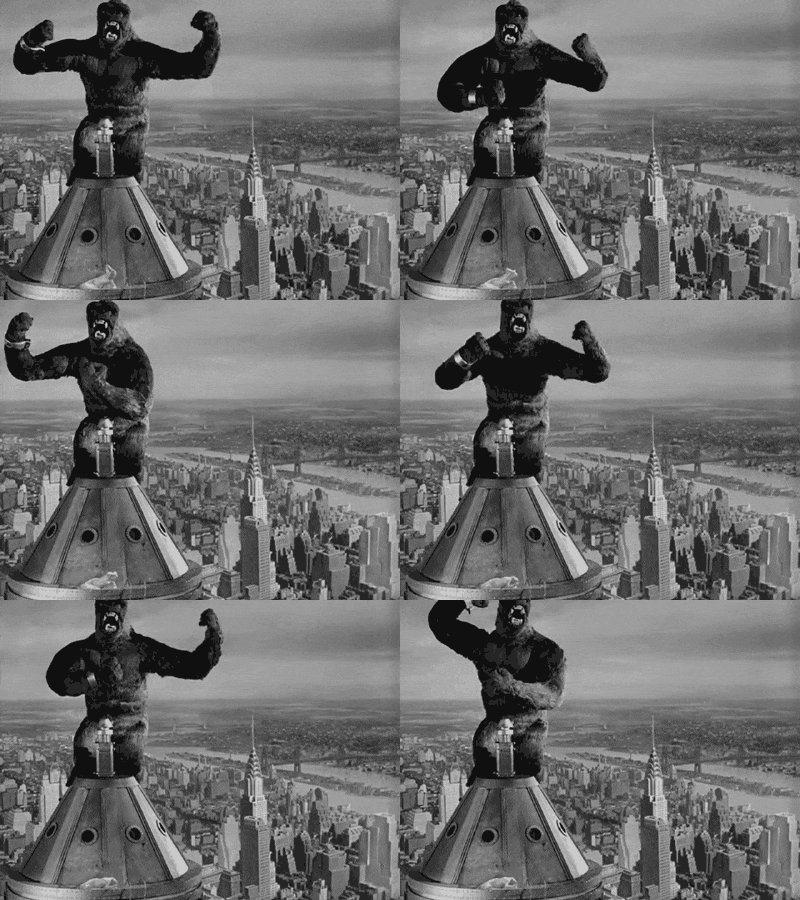
Image result for king kong gifThis movie is about a crew of explorers, looking for petroleum, that reach a deserted island. There, they meet some natives, the chief of which wants to marry the one woman in the group of explorers. When she refused, she was kidnapped and offered to the giant gorilla as a sacrifice. The monster is surprisingly kind and listens to the woman talk and dance. After the woman is rescued, the crew decides to bring Kong back to New York City to make money, as the oil wasn't high quality. When tons of reporters rush at the woman to ask her about Kong, he believes that she is being hurt and breaks free, causing widespread panic. Macbeth would absolutely recommend this movie for so many different reasons. First of all, he could really connect to the crew's desire for money and power. Macbeth was also quite greedy in this way, willing to commit all deeds to become King. Macbeth could also really relate to the gorilla. Kong was seen as a monster and killer, someone to fear, but was really sweet-hearted. In New York City, he just wanted to protect his friend and was looked on as a vicious and cruel monster. Macbeth could relate to this because Lady Macbeth had really urged him to commit murder. Although he did want power, it was not his idea or intent to murder many people and their families. Macbeth would highly recommend this movie because it might show people how he wasn't a villain after all!


3. Psych


Image result for psych gifThis TV show is a comedic detective show about the Santa Barbara Police Department. The protagonist is a self proclaimed psychic that uses his talents to solve crimes for the police department. These crimes range from robbery to murder and everything in between. He actually just has a photographic memory and is extremely vigilant, but very few people actually know the truth, including his own girlfriend (this doesn't go over too well when she does find out). This show details a new crime each episode, and also explores the personal lives of each of the characters. A huge theme in the show is making fun of the protagonist's masculinity for comedic affect. Macbeth would sympathize with the main character because Lady Macbeth is constantly making fun of Macbeth's own masculinity. Therefore, Macbeth would find the plot of the show very intriguing to see someone with a common trait, that is often made fun of, and how another person copes with this. He also might get some great ideas of ways to get away with murder and some common downfalls to avoid. He would highly recommend this movie because he could find some interesting things that he could apply to his own life.

4. Criminal Minds

Image result for criminal minds gifThis show is about an FBI unit that takes on some of the most difficult and psychotic cases of the cruelest cases of murder, abductions, arson, and more. They solve the cases by creating profiles for the criminals, doing in depth research to find possible suspects, matching their suspects to the profile, and then finding the criminal. It can often be very intense or scary, especially when the agents' lives are put in danger. Macbeth would find this show so intriguing because it really shows how the minds of criminals function, not always painting them in an evil light when there are extreme outside influences or the person is mentally challenged. Although the show always depicts the deed of murder, or whatever the case is, as gruesome and evil, the individuals are not always the representation of evil (although sometimes they are). Macbeth could really relate to this because just because he sees himself as a good person that has committed immoral actions. Lady Macbeth really coerced him to commit foul deeds and while his actions were terrible, he doesn't see himself as evil. This is really important in analyzing the development of the relationship between Macbeth and Lady Macbeth because it gives reason to the shift where Macbeth starts to control the marriage, rather than it being a partnership. This reveals about Macbeth that he feels misunderstood, and later isolated after the death of his wife.


5. Would You Rather

Image result for would you rather gifWould You Rather is a horror movie about seven people desperate for money that go to a mansion to play a game of would you rather. They are given a chance to leave, but after the game starts, it must be finished and they are locked inside. Once the game starts, it takes a sadistic turn where they ended up having to choose who to inflict pain upon, and ultimately who you would rather kill. In the end, the protagonist ends up winning by killing a man that had saved her life, all to get the money for her dying son. When she gets back after being gone all night, he had committed suicide. Macbeth would really like this movie because it shows all different types of people going to far extents to reach money and wealth for various reasons. Macbeth could relate to wanting to have power and wealth, as well as all of the ambition and intentions of the people too. Along with this, he could even relate to the game host because he plotted and executed murders just like Macbeth. There could be a sense of relating to each other, even though the game master was portrayed as much more evil than Macbeth. He could relate to wanting to do everything to make himself happy, being overly ambitious and murdering other people who get in their way. This reveals that Macbeth is easily persuaded to do what others want and can really relate to other people that want the same thing.

Work Cited:

Duhe, Remi. "10 Reasons Everyone Should Watch 'The West Wing.'" The Daily Free Now, 15 Nov. 1970, blog.dailyfreepress.com/2017/11/15/10-reasons-everyone-should-watch-the-west-wing/.

"King Kong (1976)" IMDb, IMDb.com, www.imdb.com/title/tt0074751/plotsummary.

Friday, December 7, 2018

The First Step Down the Primrose Path to the Everlasting Bonfire

Question 1: "Why do people who are not "evil" take the first step into evil? What, for instance, is involved in taking that first step 'down the primrose path to the everlasting bonfire' (Macbeth, 2.3)? What are the consequences of the individual choosing evil (particularly the internal consequences)? Use examples from the text to support your opinion.

People who are not necessarily "evil" take the first steps into evil for a variety of reasons that I believe fall into two main categories: external reasons or internal reasons. External reasons include outside influences on how an individual acts while internal influences deal with the individual's mind and how it is impacted by certain ideals. Each one is equally important in leading people "down the primrose path to the everlasting bonfire" where one evil or corrupt action can lead to more of these actions and the entire situation spiraling out of control (Macbeth 2.3). This quote means that everything seems to be going well as it is quite easy to commit a wrong action in the beginning, but as one continues they are really heading towards the corrupted by power and a place representing hell that they cannot return from. It is also foreshadowing for the awful events of murder that are to take place. The idea of not being able to turn back is represented in the text as Macbeth says, "I am in blood/ Stepped in so far that, should I wade no more/ Returning were as tedious as go o'er" (Macbeth 3.4.168-170). This metaphor of comparing standing in a river of blood to his own actions constructs the meaning that at this point, there is no turning around without the same consequences as continuing forward, and thus Macbeth is left with minimal options as to his next steps to continue down the path to hell.

Some of the common external reasons include social pressure to obtain wealth and power as well as the construct of authority and hierarchy of power. This is prevalent within Macbeth as there is a clear social hierarchy that correlates with the distribution of power. The context of the play, being set in 11th century Scotland, is a time and place where the feudal system dominated society to its core. At first, Macbeth is the Thane of Glamis, already retaining a good amount of power especially compared to those beneath him. Because of his valiant, brave, and heroic actions in battle against the treacherous Thane of Cawdor, Macbeth is given this title as well upon his defeat. This was one of the stipulations of the prophecy that the three witches of the play, the supernatural, gave Macbeth to detail his future very vaguely and ambiguously. Another one of the prophecies was dictated as the third witch said, "All hail, Macbeth, that shalt be king hereafter" (Macbeth 1.3.53). This influence planted the ideas power, wealth, and authority in Macbeth's head and it was not surprising that soon thereafter, Macbeth let this vision control him. His first step down the primrose path was to kill King Duncan, in attempt to become the King and make the prophecy come true. This shows the influence of the supernatural, an external factor, that caused Macbeth to choose evil over righteousness.

One very important internal reason for taking the first steps towards evil is called cognitive dissonance which is the idea of the contradiction of beliefs and action. A Huffington Post article describes it as "when people who feel they are good do bad things, cognitive dissonance makes them ignore this behavior because they can't tolerate the inconsistency between their behavior and their beliefs" (Bradberry). This relates directly to Macbeth's indecisiveness and constantly switching back and forth between different beliefs. This is exemplified as he talks to Banquo and says, "If chance will have me king, why, chance may crown me" (Macbeth 1.3.157-158). This means that Macbeth will let fate take care of what is to happen. However, the next scene Macbeth states in an aside that he must take fate into his own hands, completely contradictory to what he had previously told Banquo. He says, "That is a step/ On which I must fall down or else o'erleap,/ For in my way it lies. Stars, hide your fires;/ Let not light see my black and deep desires" (Macbeth 1.4.55-58). This is a metaphor where the step Macbeth must jump over represents Malcolm, heir to the Scottish throne. It also uses rhyme to show the external force of the supernatural but the internal reason presents itself because this is the belief Macbeth eventually acts on, but not without doubt and holding the belief that murder is wrong. The contradiction of Macbeth's beliefs and actions led him to be inconsistent and therefore succumb to both the external pressure of the supernatural as well as commit actions that he might not have done were in not for indecision. Macbeth almost ignores his bad actions of murder as he still continues to hire murderers to kill Banquo and later Macduff's family, but clearly is suffering from guilt as he sees Banquo's ghost.

Another internal reason for taking the first steps down the primrose path is called the compensation effect which is the belief that good deeds balance bad ones. This is prevalent within Macbeth as Macbeth sees himself as a generally virtuous person, especially at the beginning when her receives the high honor from King Duncan after defeating the previous Thane of Cawdor. He is introduced to King Duncan as the text says, "But all's too weak;/ For brave Macbeth (well he deserves that name)" (Macbeth 1.2.17-18). This leads him to believe that committing one horrible action, the murder of King Duncan, as per the will of his wife and to his own benefit, would not make him an awful person in general. He believes, considering the idea of the compensation effect, that he has built "moral capital" so that since he had done these great deeds risking his life to protect Scotland, one bad action would not destroy his virtue (Bradberry). This is prevalent throughout the entire text as although his guilt is revealed through his hallucinations and doubt, he never expresses concerns for the virtue of his own character but rather just his actions. This shows how he is balancing the two and therefore justifying his own actions, such as the frequent lying to Banquo, killing King Duncan, and hiring murderers for other killings too.

Some of the internal consequences of choosing evil include the ever-prevalent guilt on Macbeth and Lady Macbeth's conscience. This is seen by Lady Macbeth attempting to wash the blood off her hands in her sleep while confessing to all of her actions. She exclaims, "The Thane of Fife had a wife. Where is she now? What, will these hand ne'er be clean?" (Macbeth 5.1.44-45). This rhetorical question alludes to the murder of Lady Macduff and Lady Macbeth and her husband's role in orchestrating it. This clearly weighs heavily on her conscience as she is sleep walking as a result of it, furthering the motif of sleep revealing evil. Another internal consequence of choosing evil is seen to be anger and the radicalization of behavior. This is shown through Macbeth as he screams at Banquo's ghost as he says, "Avaunt, and quit my sight! Let the earth hide thee./ Thy bones are marrowless; thy blood is cold" (Macbeth 3.4.112-113). This quote shows Macbeth's aggression and how he is truly on edge, appearing crazy in front of everyone at the dinner in his honor. Overall, the consequences of choosing evil mainly coincide with a guilty conscience and a change in behavior, in Macbeth's case with more assertiveness and hunger for power.

Work Cited:

Bradbury, Dr. Travis. "14 Psychological Forces That Make Good People Do Bad Things." The Huffington Post, HuffingtonPost.com, 7 Dec. 2017, https://www.huffingtonpost.com/dr-travis-bradberry/14-psychological-forces-t_b_9752132.html.

Shakespeare, William. Macbeth. Edited by Barbara A. Mowat and Paul Werstine, Simon & Schuster Paperbacks, 2013.

Sunday, November 25, 2018

Double-Sided Ivory Liturgical Comb

Double-Sided Ivory Liturgical Comb with Scenes of Henry II and Thomas Becket, Ivory, BritishDouble-Sided Ivory Liturgical Comb with Scenes of Henry II and Thomas Becket, Ivory, British

Pictured above is the "Double-Sided Ivory Liturgical Comb with Scenes of Henry II and Thomas Becket", a comb made of ivory. It was created around 1200-1210 and is actually quite small at 8.6 centimeters in length, 8.6 in height, and 1.2 in width. It was made in Canterbury, England, the place of the murder of Thomas Becket on December 29, 1170. This had a great influence on shaping the scenes portrayed on both sides of the comb.


Here are my drawings of the two sides of the comb!

Thomas Becket, the son of a merchant, was born in London around 1120. He was very well educated and soon began working for Theobald, the Archbishop of Canterbury at the time. This connected him with Henry II, the two soon becoming friends. When Theobald died in 1161, Henry II replaced him with Becket. With his new position, Becket would stand for the church over the crown and soon went into exile in France because of the great conflict this posed. When he returned in 1170, four of the King's knights murdered Becket in the Canterbury Cathedral. In 1173, Becket became a saint and the pilgrimage to Canterbury Cathedral began in his honor. This context is vital to the images that are etched on the comb.

At first glance, the scenes in the middle of the comb are what is most notable. On the first side of the comb, scenes of Henry II telling Becket that he will be the archbishop of Canterbury are portrayed. The semicircle on the left shows the outside of a church while the semicircle on the right shows a boat. On the second side, the martyrdom of Thomas Becket it shown. The setting is the Canterbury Cathedral. The left semicircle shows an angel juxtaposed with the right semicircle showing a devil with a book.

Since the comb is made of ivory, the cream-colored base is consistent and does not detract from the scenes displayed. Instead, the lack of color draws the attention to the important scenes and circles on either side. But the organization of these scenes are most important to draw meaning from them. First, the boat and the church are significant because together they allude to Becket's murder in the Canterbury Cathedral. Furthermore, on the second side of the comb, the members of the church are standing on the left, next to the angel, while the knights are standing on the right, next to the devil. This creates the dichotomy of good versus evil with the idea that the Church represents all good and the knights and monarch represent evil.

On the second side of the comb, the four knights are standing together with their weapons drawn or ready to be drawn. They are all in armor. The clergymen on the opposite side are also together but are holding each other up in support. They are each wearing less strict clothing, with the folds of the cloth being etched in great detail. This creates the idea that each of the King's knights are standing next to each other but are actually isolated and individualized, each only acting in their own interest. This selfishness and greed is recognized by the devil looking over them. This is contrary to the clergymen who are working together as community for good, as represented by the angel looking them over. Their clothes are looser and able to move, rather than the knights who's armor only fits them.

On the first side of the comb, there are many swirls and flowers, while the second side has more straight lines. It also consists of mainly leaves rather than flowers. This is significant because it suggest how the first side, depicting the giving of power, showed a time of higher spirits and the growth of a new leader. On the other hand, the less decorative side of the comb suggests that something has intervened with the prosperity and growth. All of the plants stem from the middle of the comb with the scene of martyrdom, indicating that the King's knights had committed this treacherous act and had been the defining factor to disrupt the flowering growth of Becket. This reiterates the dichotomy between the King and his men being evil and the clergy being good.

This piece of art shows the religious values of the time. The context is very important because Thomas Becket was seen as a saint in the Catholic Church, a relatively new development. This shows how the Church at the time had sentiments that went against the monarchy because of their portrayal of the Church as good and the King's men as evil. Moreover, the purpose of the comb is to prepare the priest for Mass. Because of its religious purpose, it clearly favors the martyr rather than the monarch. This shapes the religious ideals of the time against the king and his establishment. This idea that art can convey societal values is still relevant today as art can reflect the thoughts of anyone at any time.


Works Cited:
"Double-Sided Ivory Liturgical Comb with Scenes of Henry II and Thomas Becket." The Met's Heilbrunn Timeline of Art History, The Metropolitan Museum of Art, https://www.metmuseum.org/toah/works-of-art/1988.279/.

"History - Thomas Becket" BBC, BBC, 2014, http://www.bbc.co.uk/history/historic_figures/becket_thomas.shtml.

Sunday, November 11, 2018

Marginalization In "Jane Eyre"

Writers often highlight the values of a culture or a society by using characters who are alienated from that culture or society because of gender, race, class, or creed. Explain how the author uses various literary devices (such as irony, characterization, and figurative language) to provide social commentary, OR how the character’s alienation reveals the surrounding society’s assumptions and moral values.

Charlotte Brontë, the author of Jane Eyre, was an English author who published her novel under the pen name Currer Bell. The protagonist in this novel is a young girl named Jane, an orphan forced to attend the Lowood Institution, a girls school for orphans and the poor wherein the girls are mistreated and not taken care of adequately. The institution is under the control of a wealthy man named Mr. Brocklehurst. In this novel, the protagonist, Jane, is alienated by those in power to show the corruption of society and how the moral values of the time were easily manipulated by those in power.

First, the marginalization of Jane’s character is used to challenge the assumption that only those in power get to negate the rights of the lower classes. This idea is revealed through the intense use of irony throughout the text. For example, Mrs. Temple, one of the caretakers, is scrutinized for feeding the girls two extra lunches when their breakfast had been inedible. Mr. Brocklehurst exclaims that this would “accustom them to habits of luxury and indulgence.” He even goes further to say that curled hair is “‘in defiance of every precept and principle of this house.’” He asks “‘does she conform to the world so openly — here in an evangelical, charitable establishment — as to wear her hair one mass of curls?’” Many of the girls are told that they are going to have all of their hair cut off, a necessity in conforming with the teachings of Christianity. Mr. Brocklehurst clearly seems to believe that proper amounts of food and the luxury of specific clothing and hairstyles goes against religious principles.

Yet, irony is presented when Mr. Brocklehurst’s wife and two daughters walk in wearing velvet, fur coats, silk, beaver hats, ostrich plumes, and other clothing of the new elegant fashion while also wearing a “false front of French curls.” Despite all of their extravagance, they had even spent their time searching the girl’s rooms to make sure they did not own any clothes too luxurious. The clear irony here shows the assumption that the upper class should have control over the rest of society, even what the lower class can own and wear. In this case, Jane and the other girls clearly do not even have the right to put their hair up a certain way. The acceptance of this denial of rights shows how this was assumed to be a common practice, but the irony of which criticizes the core of the assumption.

Second, the alienation of the character of Jane is used to highlight society’s assumption that those who are not Christian are sinful and immoral. This is most notably seen through Mr. Brocklehurst’s public shaming of Jane simply based on information given to him about her life before the institution and her clumsiness. He declares, “‘this girl, this child, the native of a Christian land, worse than many a little heathen who says its prayers to Brahma and kneels before Juggernaut — this girl is — a liar!’” Here, he is implying that Jane is deceitful, ungrateful, and is marginalized by being compared to a heathen that practices Hinduism. Even though this goes against the idea of both freedom of religion and freedom of speech, it was an accepted idea in society at the time because the wealthy members of the upper class were able to control what was seen as acceptable. Brontë argues that this should not be the case through the marginalization of Jane, a small child who had been treated extremely poorly her entire childhood after the loss of both of her parents. Pulling on the emotions of the audience to react to this traumatic public shaming of a small child, Brontë is able to critique the assumption that anything that isn’t Christian is immoral.

Third and finally, Charlotte Brontë argues that wealth is a source of corruption based on how she characterizes both the upper class and the lower class, although it is assumed that the wealthy are morally righteous. This is conveyed through the exclusion of Jane. In Mr. Brocklehurst’s speech denouncing Jane as a creature of God, he says, “‘You must be on your guard against her; you must shun her example; if necessary, avoid her company, exclude her from your sports, and shut her out from your converse. Teachers, you must watch her: keep your eyes on her movements, weigh well her words, scrutinise her actions, punish her body to save her soul: if, indeed, such salvation be possible.’” It is ironic for an authority figure to preach the marginalization of a child since they are generally the ones that would preach inclusion. This promotes the idea that he is corrupt and harsh. Furthermore, Mr. Brocklehurst is characterized as a “black marble clergyman.” This paints him as very strict, rigid, and stubborn. Meanwhile, Mrs. Temple is characterized as kind and considerate as she “gently assisted [Jane] to his very feet.” This juxtaposition creates the idea that wealth has corrupted Mr. Brocklehurst and turned him into this cruel and stringent man, while the poor Mrs. Temple is still loving and sweet. This negates the assumption that the upper class is pious and morally virtuous, while painting the lower class in a much kinder light.

Overall, these assumptions reveal that the moral values of the time were not only dictated by Christianity but also the will of the upper class. There was a hierarchy of the distribution of power and the corruption of the upper class was deemed morally righteous solely based on the amount of their wealth. The members of the upper class not only had the ability to not follow their own stringent rules set in place, they also could take away the rights of the lower classes. Charlotte Brontë’s commentary criticizes these societal values and the moral standards of the time through the exclusion of the character of Jane.


Work Cited:

"Chapter VII of Jane Eyre." The Victorian Web, www.victorianweb.org/authors/bronte/cbronte/janeeyre/7.html.

Sunday, October 28, 2018

Louis Vuitton Monogram Vernis Advertisement

Image result for advertisement with 7 deadly sins

Louis Vuitton is a French retail company famous for their designer handbags, jewelry, travel luggage, and more. It has a long, rich history, as back in 1837, a then 16-year-old Louis Vuitton had chosen a career as a trunk-master and began his apprenticeship in the French capital, Paris. Years later, Vuitton would decide to open his own workshop in 1854, the start of a company that would become renowned for their merchandise after being hired by Napoleon's wife to personally handcraft her boxes and luggage.

Released in April 1999, this advertisement was created to promote the luxury brand on an international market with all of its extravagance. The advertisement is the work of the BETC advertisement agency, then known as BETC Euro Rscg Paris. It was published in Paris but was spread across the nation and then the globe because of the vast international connections the company has.

This advertisement depicts a woman with fiery red hair eating the strawberries, red currents, and cherries that are tumbling out of her handbag. The color red is given great emphasis as it is the color of all of the fruit, the woman's hair, and her nails. Even her cheeks are a darker shade of pink along with the hints of auburn and dark orange in the wood of the table. The background is a light color that eventually fades to white on the left side of the picture, accenting the foreground with the table, handbag, and most notably the woman.

The woman is wearing a simple, silk outfit and the tone of her skin is very light, directly being contrasted with her auburn hair and the deep red tones around her. This contrast is significant as it emphasizes the woman's sexuality in the picture in direct relation to the handbag that is providing her with these fruits. This layout of the picture with the woman right next to the handbag shows the bag's importance in love and sexuality. The lack of words on the advertisement not only shows the brands prominence, as no explanation is needed for who the brand is or what they sell, but also shifts the importance to the picture rather than any words that could detract from the photo.

On a larger scale, the color red symbolizes ideals such as romance, love, dominance, and sexuality in the advertisement. This constructs the concepts of lust and passion, clearly emphasized in the image. This is furthered through the use of fruit, a common symbol for pleasure and temptation. While the fruit is applicable to lust, it is also applicable to the idea of gluttony. Fruit can also represent temptation in the form of excessive eating or extravagance. This is also represented with the large amount of fruit prevalent in the picture.

The intended audience for this advertisement is adult women of all ages. It is directed for the top of the upper class economically as the brand is extremely expensive. Some of their cheapest available jewelry still costs upwards of $5,000 and their most expensive items go well beyond that.


It is also targeting women who follow the trends of society because Louis Vuitton models their items based off of the current fashions. Their brand is immensely popular, thus having merchandise from them would, in the minds of many, help boost someone's social status. This is apparent with their lack of words to describe who they are as a company in their advertisement. Furthermore, the audience has to have some cultural knowledge of the company's prestige in order to invest. This shows how the advertisement draws on the societal awareness of the company, which in turn furthers public opinion and works in Louis Vuitton's favor.

Overall, this advertisement conveys the connotation that if a woman purchases this handbag or an item from Louis Vuitton, they will have the same degree of sexuality, passion, romance, and dominance as the woman depicted in the picture. This idea is constructed by the handbag being the source of these red fruits, symbols of sexuality and romance. This is a manipulation of the audience because certain factors in the picture are clearly playing on the emotions of the audience. This advertisement uses the deadly sins of lust and gluttony to try to attract buyers that have an emotional response to these concepts, such as wanting these qualities, or what they imply, for themselves or others.

Works Cited:

"A Legendary History." LOUIS VUITTON Official USA Website, Louis Vuitton, us.louisvuitton.com/eng-us/la-maison/a-legendary-history#tumbler.

BETC Euro Rscg Paris. "Seven Deadly Sins VII." Coloribus.com, Coloribus, www.coloribus.com/adsarchive/prints/monogram-vernis-seven-deadly-sins-vii-1349605/.

"FINE JEWELRY." Louis Vuitton Jewelry - Women's Fine Jewelry in Gold | LOUIS VUITTON, Louis Vuitton, https://us.louisvuitton.com/eng-us/women/fine-jewelry/_/N-75u08p/to-2.

"Louis Vuitton Biography." The Biography.com Website, A&E Television Networks, 2 Apr. 2014, https://www.biography.com/people/louis-vuitton-17112264.

Olesen, Jacob. "Color Symbolism in Literature: What Do Colors Mean in Literature and Poetry?" Color-Meanings.com, 7 May 2015, https://www.color-meanings.com/color-symbolism-in-literature-what-do-colors-mean-in-literature-and-poetry/.

Sunday, October 14, 2018

Bee-Wolf and Honeybee

Image result for princess of crete melissa

The name Beowulf in Old English translates to mean Bee-Wolf, an Anglo-Saxon kenning for bear. This is comparable to my own name as Melissa is a Greek name that means "honeybee" or "bee". While both of these names pertain to bees, the similarities end there. In Greek mythology, the name Melissa was a feminine name that had many different important carriers that shaped the connotation of the name.

First, it was the name of the Princess of Crete who was able to turn into a bee after learning how to collect honey. This is represented in the picture above. The picture shows the connection of bees to divinity and royalty in Greek mythology. It also represents the importance of nature, fertility, and beauty as depicted by the flowers.

Second, it was the name of the nymph that took care of Zeus while he was an infant, hiding him away from his father who was planning on eating him like he had already done to Zeus's siblings. She cared for him and instead of feeding him milk, she fed him honey. The name Melissae was given to all of the nymphs that cared for Zeus during his infancy in her honor.

Third, in the Goddess Aphrodite's temple, the name Melissae was collectively given to her priestesses while the name Melissa was given to the Goddess herself, directly meaning Queen Bee. This shows the divinity and crucial role that bees played in Greek mythology. Bees were sacred in Greek mythology for their integral role in agriculture, their symbol of fertility, their matriarchal society, as well as the understanding they gave to the universe through geometry.

While my name does not define me in the way that I see myself, it is interesting to think about how it could change the way others perceive me even before they have gotten to know me. My name has a significant nurturing and caring connotation in Greek mythology that could pose expectations on me, as any name with a certain meaning could. This is interesting to think about in relation to Beowulf as well because with his name meaning bear, his name, father's reputation, and societal norms were all weighing on him to be heroic, strong, and a capable warrior. His name added more pressure for him to succeed. I do not find that this is the case for my own name because I was not named specifically after someone else and only with a lot of research did I discover the true origins of my name. Despite not being applicable to me, pressure from one's name is definitely still prevalent now as people have to live up to certain standards or feel pressured to follow the footsteps of their name-sake.

In her essay "The Name is Mine", Anna Quindlen speaks about how there is one version of herself that is an individual and another that is a part of her family of four. She goes on to discuss how this  marginalizes her, with the three other family members sharing a different name. In regards to my own life, there have been two versions of myself when one version is me as an individual and the other is me as a twin. While my twin, Nicole, and I are two extremely different people in the way we think and act, we still share a bond that connects us both by our own definitions as well as society's.

These two versions of myself pose dilemmas in more than one facet, but most remarkably in social settings. Beyond the common mixing of names, which happens more often than one would think with fraternal twins, the two versions of myself work against each other in this setting quite often. While Nicole and I are both very different individuals, we are often perceived as just one unit. But in some regards, we are almost polar opposites of each other and so when taken together as one, it is often difficult to express our vibrant individuality and unique traits. For example, Nicole loves dancing, singing, and other means where she can express her creativity and artistic abilities. This completely contrasts with my own love for soccer, math, and science. When we are taken together as one unit, it can be difficult to each show our own unique capabilities. I find that when we are together, we are referred to as "the twins", or some variation of the sort, that undermines our individuality.

This is often difficult to deal with because the standards that one twin sets often puts pressure on the other one to do the same. For example, if Nicole does really well in all of her classes, I feel pressure to do the same. While this can be motivating in many cases, the pressure can make one of us feel inadequate if we don't do as well as the other. It is as if we feel like others are constantly comparing the two of us because they see us as one entity and thus we each do not want to be seen as the "lesser twin" in any way. Thus, lumping us together puts a lot of external pressure on each of us to do as well as the other one. This imposes yet another standard that limits our individuality as we are trying to conform to the each other's goals and expectations.

While this is one way to look at it, another is to say that being a twin is unique in and of itself. Being referred to as "the twins" is special because while everyone else is their own entity, we are each half of a whole. Not everyone has this special bond with someone that they have lived their entire life with and grown up together with. This has its own advantages in a social setting as well because I have met a lot of new people through those that Nicole has become friends with, and the same is true for her. So while it can often be difficult as not being thought of as my own individual, it has its unique characteristics that can make it very special. The two versions of myself do often clash, so finding the place where we each feel we can express our individuality, while still sharing a connection, is vital to having a healthy bond between the two of us.

Works Cited:

Maes, Annemie. Melissa: The Origins of the Word Honey Is Feminin, annemariemaes.net, annemariemaes.net/melissa-the-origin-of-the-word-honey-is-feminin/.

"Melissa." The Bump, www.thebump.com/b/melissa-baby-name.

"The Melissae of Ancient Greece." Blue Star Owl, 9 Apr. 2013, bluestarowl.wordpress.com/2013/04/09/the-melissae-of-ancient-greece/.

"Nymphs." Paleothea, 16 July 2011, www.paleothea.com/Nymphs.html.

Zupan, Melissa. "The Melissae in Greek Myth and Legend." Three Hundred and Sixty-Six, 3 May 2013, threehundredandsixtysix.wordpress.com/2013/05/03/the-melissae-in-greek-myth-and-legend/.

Newest Post!

Rubik's Cube

Hey everyone! For my last blog post I wanted to do something creative and reflective that was also unique and meaningful specifically for m...